A full-function accounting engine behind every broking feature.
All of EbixEvolution's broking and underwriting features are backed by a full-function accounting system handling banking, settlements, journals, payments, and reconciliations, with an optional fully integrated multi-company, multi-currency General Ledger for a complete end-to-end view of financial performance.
the module, end to end
From banking to statutory reporting
Broker accounting fails when it is a second system. In EbixEvolution the accounting engine is written by the broking transactions, so the high level of interaction between broking functions and financial reporting is itself a management tool.
Banking, settlements, journals, payments
The common transactional processing of a brokerage, handled in the same system as the broking, so the financial position and the book agree.
Reconciliations
Bank, client, and insurer reconciliations from the accounting engine, with total financial visibility and accuracy.
Premium tracking and allocation
Premium tracked and allocated across sections, insurers, and parties, for the financial complexity typical of large brokerage operations.
Commission and brokerage management
Commission and brokerage by insurer, product, and line, calculated on every transaction.
Optional integrated General Ledger
A true multi-company, multi-currency General Ledger, implemented with or without the broking modules. Integrated, it generates insurer settlement cheques, client refunds, and statutory reports automatically.
Cash or accrual accounting
Daily, monthly, and annual closings, programmable or staggered, with pre-processing validations, and an accounting book with detailed and grouped records.
Full accounting controls and audit trails
System-maintained audit trails and full transaction history, with an Enquiry and Report module for transaction and balance level access.
Hierarchy by company, branch, or cost centre
Financial structure configured to the organisation, for groups with several entities and offices.
Ledger entries from the policy
Binding, endorsing, renewing, and cancelling raise the accounting entries. Nothing is journaled by hand to match a policy transaction.
Client ledger
Invoices, receipts, credits, and balances by client, with open items and ageing visible on the client file itself.
Insurer ledger
Premiums due to each insurer, net of commission, with settlements prepared from the ledger and reconciled against insurer statements.
Receipting
Client payments receipted against invoices, in full or in part, with unallocated cash tracked until it is applied.
Insurer settlements
Settlement runs by insurer and period, with the statement and the remittance produced from the same figures.
Commission and fees
Commission by insurer, class, and product, broker fees, and producer splits calculated on every transaction.
Multi-currency
Programmes invoiced, receipted, and settled in the currency each party works in, for corporate and international broking.
Automatic payment uploads
Payment files from your bank or card provider upload into Evolution automatically, negating the need for manual receipting.
Statutory and management reporting
Full control over the content and layout of management reports, with statutory reports produced from the General Ledger.
One connected flow to the ledger
Prospects, quotation, clients, policies, placing, and invoicing feed directly into sub-ledger and general ledger financial accounting, alongside claims management and time recording.
Day-end audit-trail reports
As part of the day-end process the system produces a full set of audit-trail reports covering all accounting transactions, with finance operation reports and management reporting on revenue and claims.
Electronic banking pay files
Automated electronic banking pay-file processing for insurer settlements, client refunds, and supplier payments.
Scheduled end-of-day and end-of-month
End-of-day and end-of-month runs scheduled rather than started by hand, with their reports produced as part of the run.
AI premium reconciliation, in production
The Ebix Integrated Reconciliation Service matches and posts broker payments without manual keying, with every posting auditable and a person in control. See AI for brokers.
Inside the module
Insurance technical accounting, the day-end reports, and the analysis views, as the accounts team uses them.
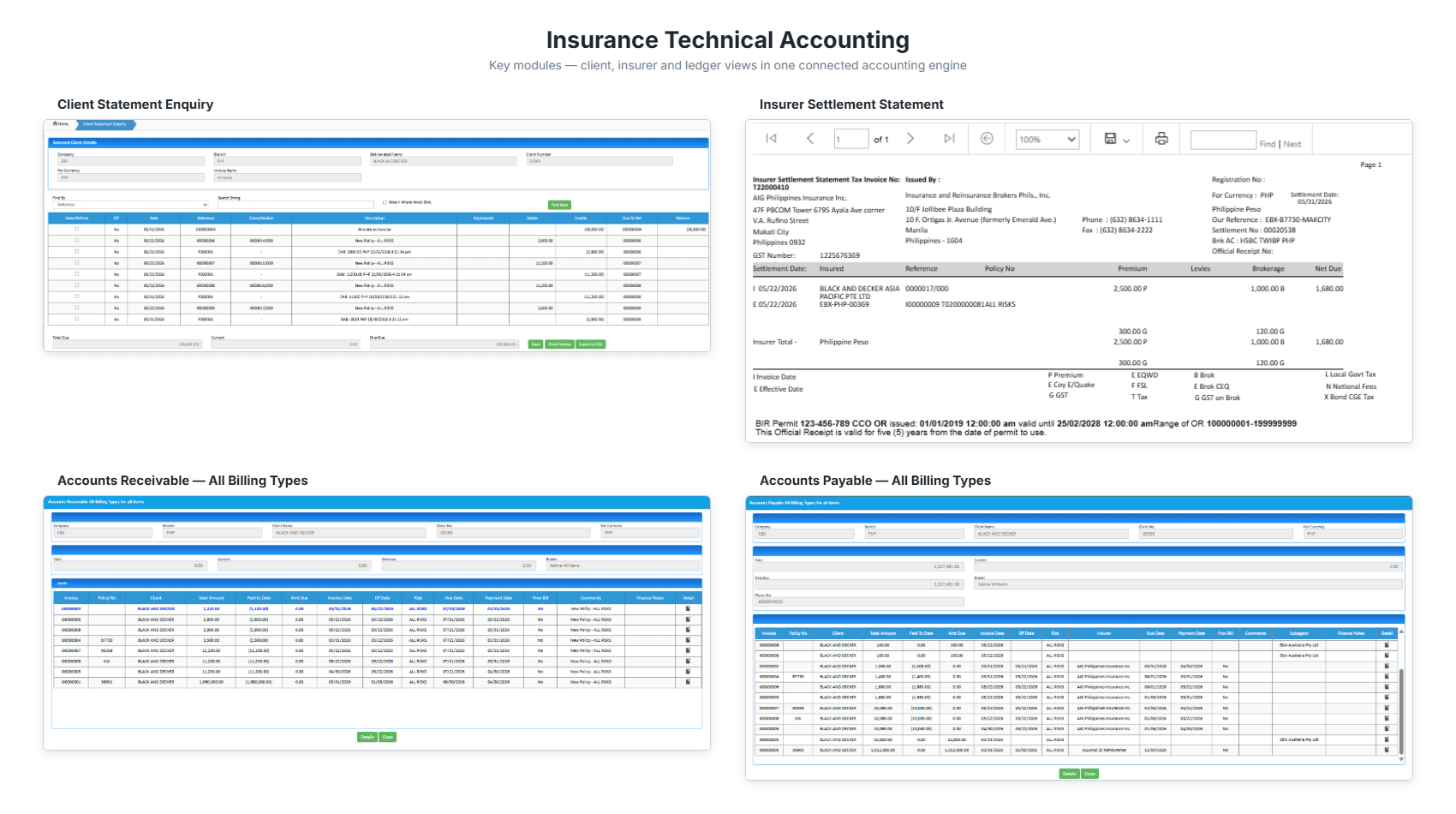
Insurance technical accounting
The client statement enquiry, the insurer settlement statement, and accounts receivable and payable across all billing types, on one connected accounting engine.
- Client statement enquiry
- Insurer settlement statement
- Receivables and payables, all billing types
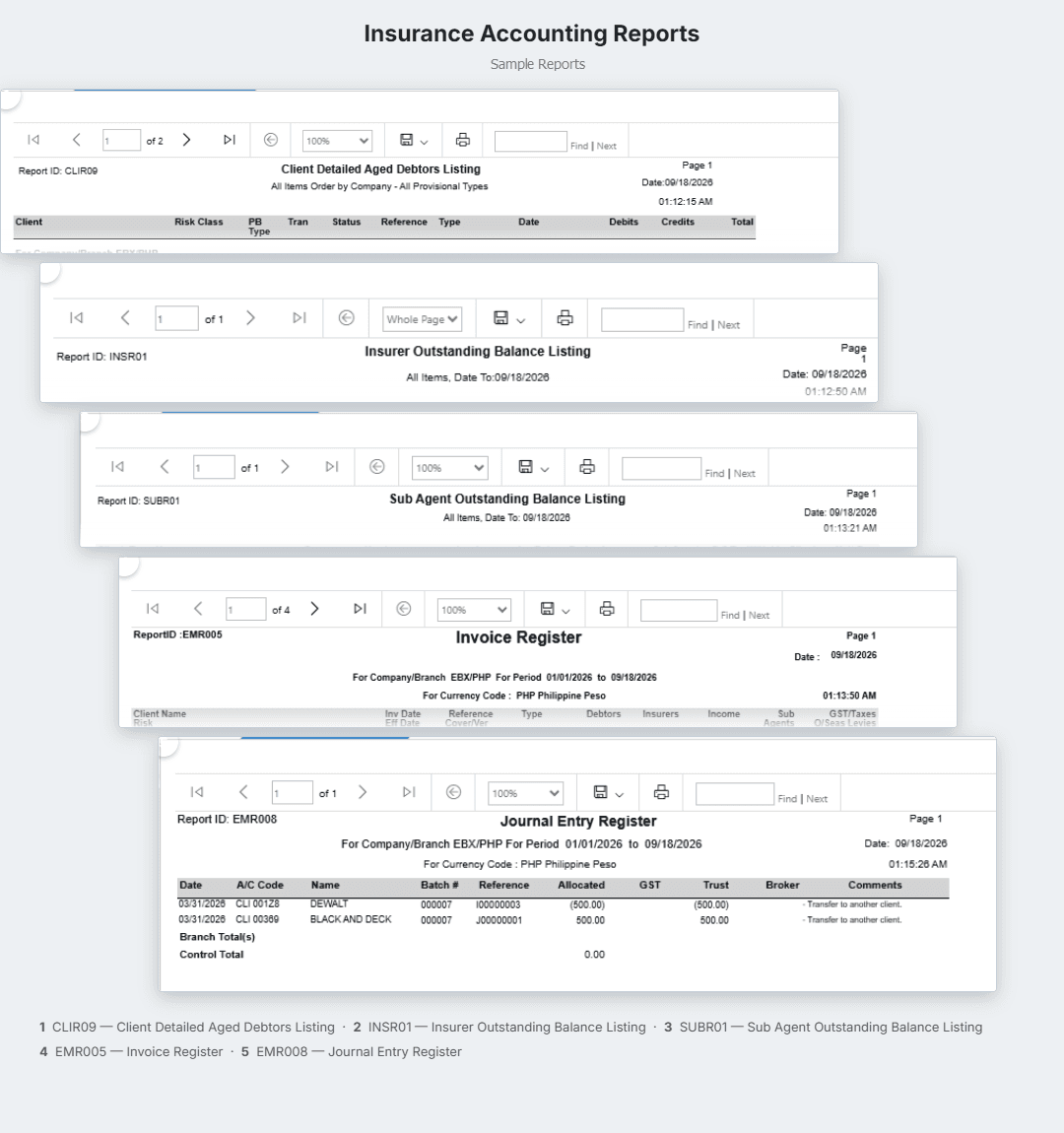
The inbuilt system reports
Client detailed aged debtors, insurer and sub-agent outstanding balances, the invoice register, and the journal entry register, produced as part of the day-end run.
- Aged debtors by client
- Insurer and sub-agent outstanding balances
- Invoice and journal entry registers
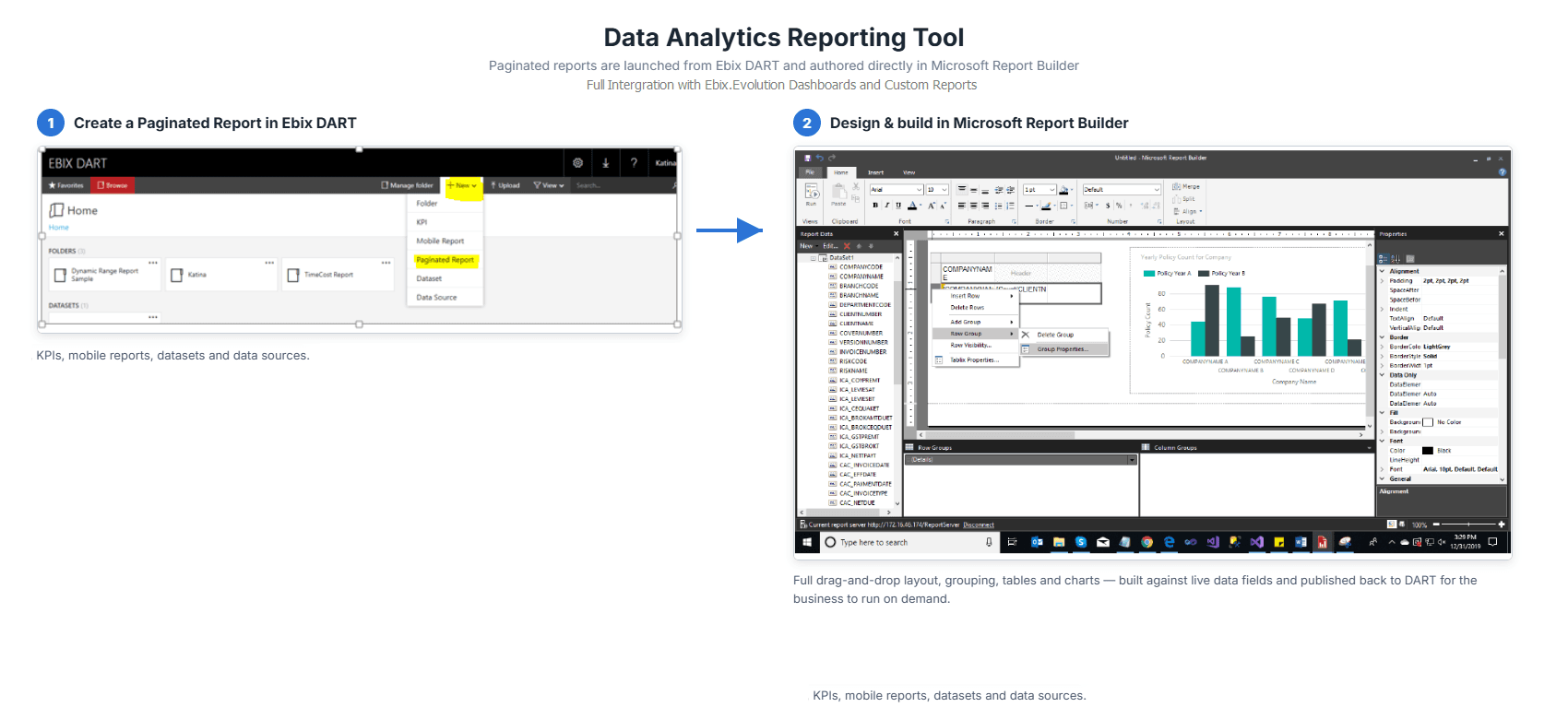
Income and receivables, any cut
Commission and fee income by insurer, class, and producer, and receivables by age, from the same ledger, built in DART and published to the dashboard.
- Income by insurer and class
- Receivables ageing
- Producer splits
Actual product screens, shown as configured and white-labeled for RedGram Wealth Management, an investment advisory firm running on Ebix Meridian. Your firm gets the same portal under your own brand.
Accounting that follows the market.
Client money rules, settlement conventions, and tax treatment differ between the United States, the United Kingdom, Australia, New Zealand, and Brazil. EbixEvolution is configured for each market by the Ebix team that delivers it there.
Client money, settlement, and tax handled the way each market expects.
Corporate and international programmes in the currency each party works in.
Journals and statements out to the general ledger you already run.
What the accounts team stops doing
When the ledger is written by the policy transaction, a set of daily reconciliations simply stops being necessary.
The invoice is raised when the policy binds.
The journal is the policy transaction.
Settlements come from the ledger for each insurer and period.
Service staff see the balance on the client file.
Bring last month's
insurer settlement
See how the same settlement is prepared, reconciled, and remitted on the platform.